
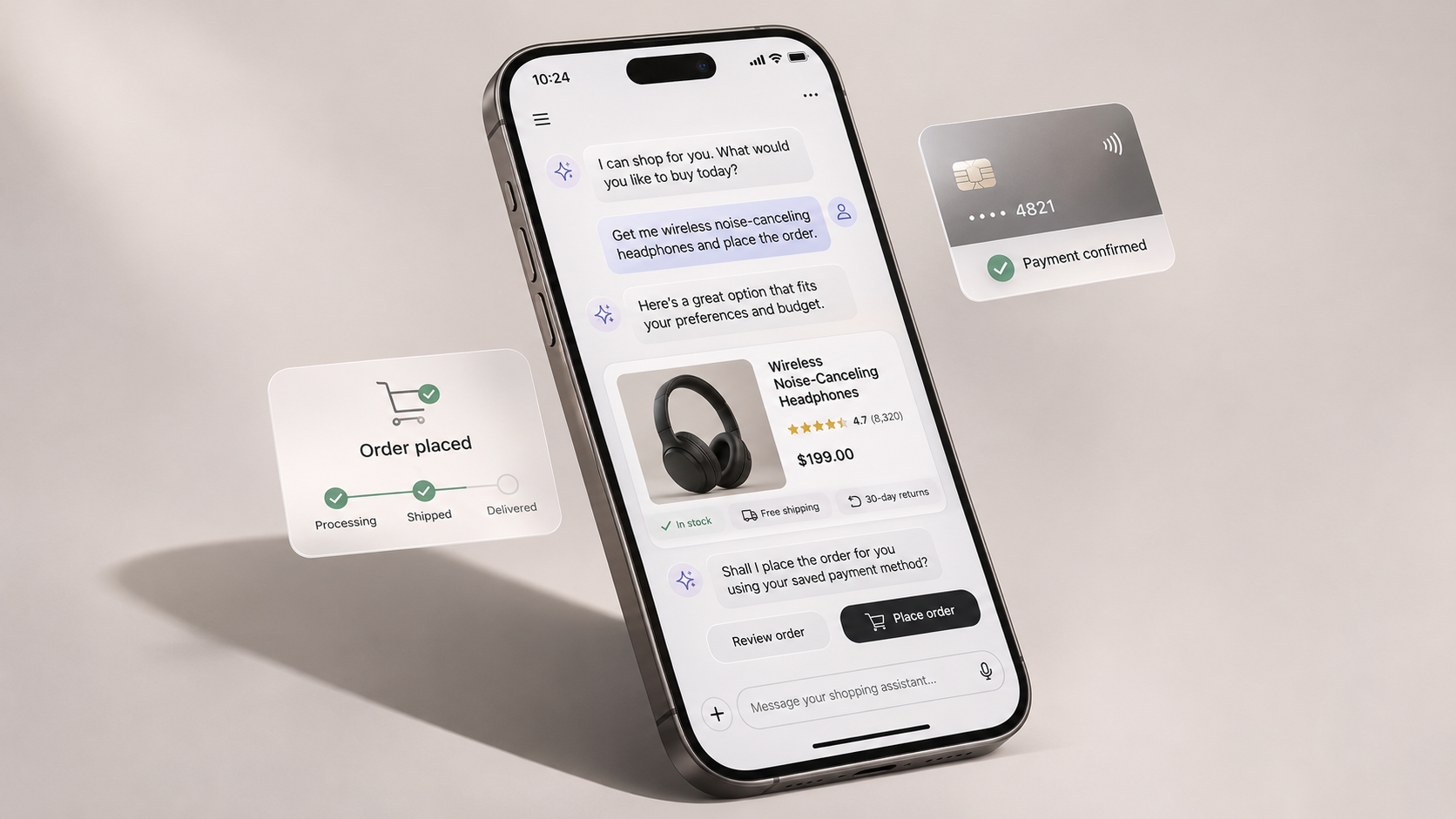
ChatGPT can now help complete a purchase, not just recommend a product. On November 13, 2026, OpenAI introduced ChatGPT Wallet, a payment feature designed for AI agents to buy from existing online stores after the shopper reviews and approves the transaction. The early rollout is limited, but the launch raises a practical question for retailers: can an AI agent actually use your store’s checkout?
For eCommerce businesses, the immediate challenge isn’t adding a chatbot to every page. It’s ensuring that product information, inventory, checkout, fraud protection and order confirmation remain reliable when a shopper uses an agent instead of browsing manually.
For shoppers
An eligible user can save a card, review an order and approve a purchase with a security check instead of re-entering card details.
For store owners
The merchant still processes the order, controls prices, fulfills purchases, handles returns and keeps the customer relationship.
Limited launch, not universal availability
ChatGPT Wallet initially rolls out through dots for eligible ChatGPT Pro subscribers aged 18+ in the United States with eligible US-issued cards. It is not available to every ChatGPT user or merchant checkout.
What is ChatGPT Wallet?
ChatGPT Wallet is a payment feature for agent-assisted shopping. Users can add an eligible payment card and authorize a specific purchase when an agent has located a product and prepared an order. Rather than giving the merchant or agent the card’s actual details, the system uses a payment token linked to the selected card.
OpenAI announced the feature with American Express, Chase, Mastercard and Visa. The merchant remains the seller. ChatGPT is helping with the checkout process, not becoming the warehouse, shipping provider or refund department.
How does an AI purchase actually work?
Shopping with ChatGPT Wallet: five steps
01 / Find The shopper asks an AI assistant to find or compare an item.
02 / Select The agent identifies an option and prepares a checkout with the merchant.
03 / Review The shopper checks the merchant, item, price, delivery details and selected payment card.
04 / Approve A security check, such as a biometric confirmation, authorizes that specific purchase.
05 / Complete The merchant’s checkout receives the payment credential and processes the transaction, subject to its normal acceptance and fraud checks.
The agent cannot assume that a purchase succeeded just because the user approved it. A card issuer or merchant may still decline the transaction. The customer’s approval applies to the disclosed order details; material changes can require another review.
Can ChatGPT pay on any online store?
Not yet in practice. OpenAI says ChatGPT Wallet is designed to work with existing checkout pages and payment forms without requiring a special Wallet integration. However, bot challenges, website restrictions, payment risk checks and unsupported checkout flows can prevent an agent from completing an order. Availability also depends on the user, merchant and card.
No Wallet plugin is required just to receive a payment
OpenAI’s merchant guidance says existing checkout pages can support Wallet payment tokens. Optional deeper integrations can improve product discovery and cart handling, but installing an unknown “ChatGPT Wallet plugin” is not a prerequisite.
What changes for eCommerce websites?
Until recently, many stores designed every step around a human visitor tapping through categories, reading product pages and filling in checkout forms. Agent-assisted shopping introduces another customer journey: software may retrieve product information, navigate the website and prepare the order while the customer supervises.
This doesn’t eliminate the website. The store still needs accurate product pages, reliable pricing and availability, valid checkout logic and an order-management system. A beautiful homepage alone does little to help an agent determine whether a product can be shipped tomorrow.
Before AI-assisted shopping
Discovery through search, ads or social media; a person navigates product pages and completes checkout.
With an AI shopping agent
An assistant may compare products, prepare the cart and enter an existing merchant checkout with shopper approval.
Five things Shopify and WooCommerce stores should check
1. Keep product information accurate and accessible
Product names, prices, variants, shipping limits, stock status and returns policies should be consistent across your catalog and website. AI shopping experiences depend on correct product data. OpenAI’s commerce documentation also supports merchant product feeds for richer product discovery.
Shopify merchants have product data integrated into ChatGPT through Shopify Catalog, according to OpenAI. Individual merchant visibility is still subject to product eligibility and relevance. WooCommerce operators should review the applicable product feed integrations and their specific merchant eligibility instead of assuming every item is automatically listed.
2. Check what your firewall blocks
Some security systems treat an AI agent’s hosted browser as unwanted automation. An overly aggressive challenge can interrupt a legitimate purchase just as the customer is trying to check out.
Review firewall and CDN logs during a controlled test. OpenAI recommends recognizing signed agent requests using Web Bot Auth where supported. Do not disable anti-fraud or bot protection globally just to make an agent pass.
3. Test checkout with variants, tax and shipping
A straightforward single-item order may succeed while a store with variant-dependent prices, coupons, address validation or international shipping fails. Test actual carts, not just whether the checkout page loads.
- Confirm the selected variant, quantity and stock are preserved.
- Check tax, shipping fees and the final total before payment authorization.
- Verify guest checkout and required account sign-in paths.
- Confirm that failed payments do not create completed orders.
- Check the confirmation page and transactional email after purchase.
4. Investigate false fraud declines
OpenAI notes that fraud systems may flag legitimate agent purchases. If a processor sees a cloud browser rather than a conventional shopper session, it may treat the order as suspicious. Work with the payment and fraud providers to understand supported agent signals while preserving real protections.
Ask your payment provider a specific question
Can your existing fraud rules distinguish an authenticated AI shopping session from malicious automated checkout attempts? Record test failures and request documentation before modifying production risk settings.
5. Make customer support and returns obvious
The store, not the AI assistant, is still responsible for fulfillment and service. The checkout confirmation must identify the merchant and provide the information necessary to track an order, contact support or request a return.
Is this different from buying directly inside ChatGPT?
Yes. ChatGPT’s earlier shopping experiences included product recommendations and, for eligible merchants, in-chat purchasing. In March 2026, OpenAI emphasized richer product discovery and merchant-owned checkout. ChatGPT Wallet adds a way for eligible agents to pay through existing merchant checkout systems after user authorization.
For the retailer, the distinction matters: being discoverable in ChatGPT, supporting an agent’s browser access and providing a functioning payment checkout are related but separate requirements.
Does a WooCommerce store need to be redesigned?
Not automatically. An existing WooCommerce store with clean product data, accessible pages, a stable payment provider and a tested checkout might need little visual redesign. A store that relies on fragile JavaScript, popups, inconsistent variant data or poorly configured bot challenges may need more substantial work.
Before rebuilding a checkout, audit it. Use a staging environment and a test payment method where available. Do not make a real purchase merely to prove a layout renders correctly.
What about security and customer control?
ChatGPT Wallet is designed around user approval and tokenized payment credentials. OpenAI says the agent and merchant don’t receive the underlying physical card details through Wallet. The user reviews transaction details and approves the purchase, and existing issuer protections may apply.
That doesn’t mean AI-driven checkout is risk-free. Agents may select the wrong variant or misunderstand an offer. A payment can be declined. Users should review each order rather than granting a purchase without checking its contents. Merchants should continue using their normal order validation, fraud checks and customer-service procedures.
Will AI agents replace traditional online shopping?
ChatGPT Wallet is evidence of another shopping channel, not proof that traditional stores are disappearing. Customer adoption, merchant compatibility, payment coverage and trust will determine how widely agent-assisted checkout is used.
For most businesses, a sensible approach is to keep investing in the essentials: accurate catalogs, useful product descriptions, fast mobile experiences, trustworthy checkout and clear policies. Those improvements benefit both human shoppers and AI-assisted journeys.
A practical readiness checklist for online stores
AI-shopping readiness: where to start
Catalog: Price, stock, variant names and product identifiers are consistent.
Discovery: Product pages and supported merchant feeds are accurate.
Access: CDN and firewall policies are checked for legitimate agent sessions.
Checkout: Shipping, tax, coupons, payment outcomes and confirmations are tested.
Fraud: The payment provider’s guidance is reviewed before rule changes.
Support: Customers can clearly identify the merchant, contact support and manage returns.
Frequently asked questions
When did ChatGPT Wallet launch?
OpenAI announced ChatGPT Wallet on November 13, 2026, with limited initial availability.
Can ChatGPT purchase something without asking me?
At launch, each purchase requires user review and approval with a security check. OpenAI describes broader pre-authorized delegation as a possible future direction, not a generally available capability in this initial rollout.
Does it work with Shopify?
Shopify product discovery is integrated with ChatGPT through Shopify Catalog. For an agent to complete a purchase, the merchant’s actual checkout and risk systems must also work with the agent flow.
Does it work with WooCommerce?
ChatGPT Wallet is intended to operate with existing checkout pages, but compatibility should be tested with your specific plugins, payment provider, shipping logic and security configuration. There is no guarantee for every installation.
Is ChatGPT Wallet available outside the United States?
The initial rollout is limited to eligible adult Pro subscribers in the US with eligible US-issued cards. Availability may expand later.
Will store owners pay OpenAI a special Wallet processing fee?
OpenAI’s introductory merchant guidance does not require a Wallet-specific integration for an existing payment form. Merchants should check their own processor, platform and partner agreements for applicable payment or service fees instead of assuming a universal rate.
What online stores should do now
Prepare for an additional customer journey, not a replacement for the entire website. A dependable catalog, accessible checkout, sound payment security and transparent order handling remain the foundations.
Build a store that works for real customers
Vectorbolt develops WordPress and WooCommerce websites, including product variations, custom checkout logic, integrations and ongoing maintenance. If your store has checkout errors, unreliable product data or custom functionality that needs attention, discuss your eCommerce project.
Sources
- OpenAI: Introducing ChatGPT Wallet (November 13, 2026)
- OpenAI developer documentation: Accept payments
- OpenAI: Powering Product Discovery in ChatGPT (March 24, 2026)
- ChatGPT Wallet terms and eligibility
Reviewed November 19, 2026. Availability, payment partners and merchant capabilities may change after publication.
